Road Traffic Concepts
The essentials
This topic explains the basic concepts and terms used in road traffic rules. Correct definitions matter because words such as road, lane, stopping, parking, overtaking and others have precise legal meanings in the rules.
What to remember
Learn the terms by their exact legal meaning because ‘stopping’, ‘parking’, ‘overtaking’, ‘passing’, ‘give way’, ‘main road’, ‘carriageway’ and ‘lane’ are different legal concepts. The correct answer often depends on a single word. For example, having priority does not remove the duty to act safely, and ‘give way’ does not require a stop if priority traffic can be allowed through without stopping.
Listen to the explanation
Educational material; not a substitute for the current official rules.
Try questions on this topic
A small practice set from this subtopic. The full question bank and saved progress are available in your account.
According to the RA Law "On Ensuring Road Traffic Safety", the traffic direction on the roads of the Republic of Armenia is:
- Right-hand traffic.
- Left-hand traffic.
The correct answer: Right-hand traffic.
The correct answer is “Right-hand traffic.”. The correct option must satisfy every element of the definition, not merely its general idea. Remember the complete definition, not an approximate paraphrase. The other options change or omit at least one defining condition—such as an age, period, exception or scope—so they do not match the source definition in full.
This sign is called:
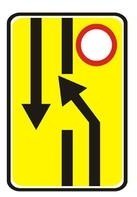
- Advance indication of bypassing an obstacle.
- Advance indication for changing to another lane.
- Advance indication for entering the opposite traffic lane.
The correct answer: Advance indication for changing to another lane.
The correct answer is “Advance indication for changing to another lane.”. The decisive details are the sign category, symbol and any supplementary plate; together they give the exact instruction. Remember: category first, symbol second, supplementary plate last. The other options change the required direction, signal or path and therefore do not match the requirement shown or described.
An intersection is considered regulated if the traffic sequence is determined by:
- Only by traffic light signals.
- Only by the signals of a traffic controller.
- By both.
The correct answer: By both.
The correct answer is “By both.”. The order is determined by active control and priority signs, then by road status and, under equal conditions, the right-hand rule and intersecting paths. Remember the order: control → priority signs/road status → right-hand rule when conditions are equal.
Continue your learning journey
Your account brings together the full question bank, a personal plan, reviews and progress tracking.
Create an account and continue