Emergency Vehicles
The essentials
This topic concerns emergency vehicles operating with special light and sound signals. The learner should notice them in time, understand their direction of approach and safely provide the necessary free space and passage.
What to remember
When giving priority to an emergency vehicle, do not stop at a random place or block an intersection. First determine where it is approaching from, then predictably reduce speed or change position to clear the route. The driver of the emergency vehicle must also make sure others have noticed it, but an ordinary driver’s duty is not to obstruct its priority movement.
Listen to the explanation
Educational material; not a substitute for the current official rules.
Try questions on this topic
A small practice set from this subtopic. The full question bank and saved progress are available in your account.
Which vehicle must you give way to if you intend to make a left turn at an intersection?
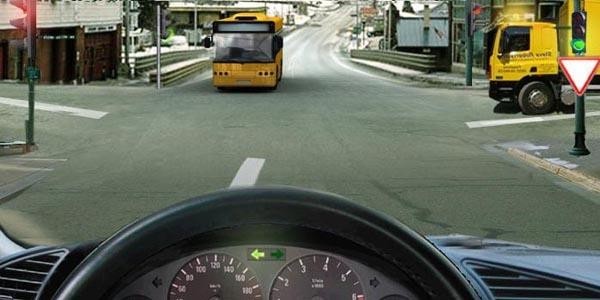
- None
- Bus only
- Only to a truck with flashing beacon on
- Both vehicles
The correct answer: Bus only
The correct answer is to yield only to the bus. When turning left, you give way to the oncoming bus traveling straight. The truck’s yellow or orange beacon only warns of special work or danger and does not grant priority. The truck also faces a Give Way sign and must wait.
The vehicles will pass the intersection in the following order:
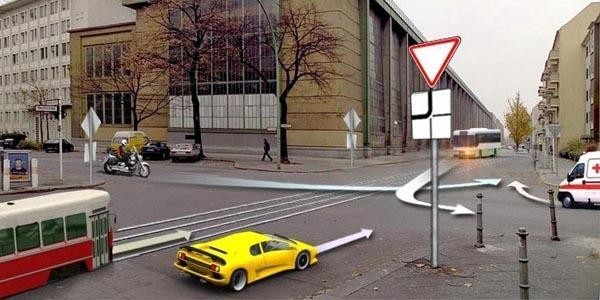
- Ambulance, tram, motorcycle, bus, light passenger car.
- Motorcycle, bus, tram and ambulance, light passenger car.
The correct answer: Motorcycle, bus, tram and ambulance, light passenger car.
The correct answer is “Motorcycle, bus, tram and ambulance, light passenger car.”. The order is determined by active control and priority signs, then by road status and, under equal conditions, the right-hand rule and intersecting paths. Remember the order: control → priority signs/road status → right-hand rule when conditions are equal.
When approaching a stationary vehicle with a red flashing beacon turned on, drivers of public vehicles traveling in that direction must:
- Stop and continue driving only after receiving permission.
- Reduce speed to be able to stop immediately if necessary.
- Continue driving since they are on a designated route.
The correct answer: Stop and continue driving only after receiving permission.
The correct answer is “Stop and continue driving only after receiving permission.”. Applying the relevant road rule to the conditions described in the question leads to this result. The decision should be based on the signs, markings and positions of road users rather than on the overall appearance alone.
Continue your learning journey
Your account brings together the full question bank, a personal plan, reviews and progress tracking.
Create an account and continue