Lane Changing
The essentials
A lane change is a maneuver from one lane to another. This topic teaches how to assess the adjacent lane in advance, maintain safe clearance, signal and correctly determine priority when several vehicles are changing lanes at the same time.
What to remember
When changing lanes, the driver who is changing lanes must make sure not to interfere with vehicles already travelling in the destination lane. If two vehicles simultaneously intend to change lanes toward each other, the applicable mutual-priority rules are used. Simply switching on a turn signal does not oblige another driver to let you in.
Listen to the explanation
Educational material; not a substitute for the current official rules.
Try questions on this topic
A small practice set from this subtopic. The full question bank and saved progress are available in your account.
A traffic circle is arranged at the intersection. The roadway you are approaching an intersection has two lanes. Which lane do you have to take to turn when entering the intersection?
- Right lane
- Left lane
- Right or left lane
The correct answer: Right or left lane
A roundabout may be entered from either the right or left lane unless signs or lane markings prescribe another arrangement. Choose the lane according to the intended exit and avoid abrupt lane changes. When entering, also obey the priority signs and yield to traffic that has the right of way.
When crossing the road concurrently with oncoming vehicles, the road must be given way by
- The driver of the vehicle on the left
- The driver of the vehicle on the right
The correct answer: The driver of the vehicle on the left
The correct answer is the driver on the left must yield. When two vehicles traveling in the same direction change lanes simultaneously, the right-side priority rule applies. The driver positioned on the left lets the vehicle on the right move first, checks the lateral space, and completes the lane change afterward.
Must the bus driver on the established route give way in this situation?
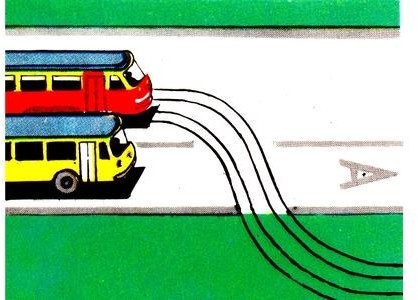
- He must
- He must not
- He must not, because he is driving straight ahead
The correct answer: He must
The correct answer is the bus driver must yield. Priority given to a route vehicle leaving a stop does not permit it to cut across a vehicle that is already alongside or too close. The bus driver must first confirm that other traffic is yielding and that the merge is safe, then enter the lane.
Continue your learning journey
Your account brings together the full question bank, a personal plan, reviews and progress tracking.
Create an account and continue