Left Turn
The essentials
A left turn requires the correct initial position, assessment of oncoming traffic and giving way where necessary. This topic teaches how to build a safe path while accounting for traffic lights, signs, trams, pedestrians and other vehicles.
What to remember
Before turning left, take the position permitted by the rules, then assess oncoming traffic. On a green signal, a non-rail vehicle turning left gives way to oncoming vehicles travelling straight or turning right. When completing the turn, do not enter the lane of oncoming traffic and account for pedestrians crossing your path.
Listen to the explanation
Educational material; not a substitute for the current official rules.
Try questions on this topic
A small practice set from this subtopic. The full question bank and saved progress are available in your account.
What sign is called "An obstacle bypass on the left"?
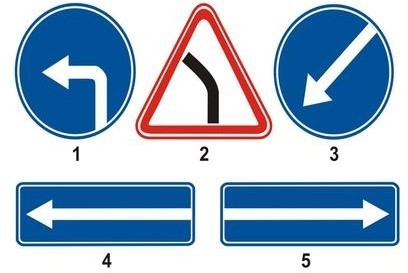
- 1
- 2
- 3
- 4
- 5
The correct answer: 3
Sign 3 is correct. Its white arrow points diagonally down and left inside a blue mandatory circle, requiring the obstacle to be passed on the left. This is not an ordinary left-turn sign: the blue circle means a mandatory action and the arrow identifies the required side of passage.
Moving to the leftmost lane on two-way roads with three lanes marked with markings, of which the middle lane is used for traffic in both directions (except for roads with reversing traffic control)
- Allowed
- Prohibited
- Allowed, only to overtake, bypass, turn left or U-turn.
The correct answer: Prohibited
Entering the far-left lane is prohibited because it belongs to opposing traffic. On this three-lane two-way road, only the middle lane may be used temporarily for overtaking, passing an obstruction, turning left, or making a U-turn. Those manoeuvres do not permit entry into the opposing outer lane.
You are driving on a two-way road with three lanes. In what case is it allowed to enter the middle lane?
- Only to overtake
- Only to go around
- Only for making a left turn or a U-turn
- In all of the above cases
The correct answer: In all of the above cases
The middle lane may be entered in all the listed cases: overtaking, passing an obstruction, turning left, or making a U-turn. It is shared by both directions and is not a normal cruising lane. Before entering, ensure it is clear from the opposite direction and return to the right lane after the manoeuvre.
Continue your learning journey
Your account brings together the full question bank, a personal plan, reviews and progress tracking.
Create an account and continue