Railway Crossing Procedure
The essentials
This topic explains the sequence for approaching, stopping at and passing a railway crossing. The learner must assess light or sound signals, the barrier, the crossing attendant’s instructions and make sure the crossing can be fully cleared.
What to remember
Cross a railway crossing only when you are sure no train is approaching and the exit is clear. When a prohibiting signal is active, priority stopping points are the stop line, STOP sign or traffic light; if none exists, stop at least 5 m from the barrier, or without a barrier at least 10 m from the nearest rail. Do not change your decision at the last moment and do not stop on the rails.
Listen to the explanation
Educational material; not a substitute for the current official rules.
Try questions on this topic
A small practice set from this subtopic. The full question bank and saved progress are available in your account.
Turning around is prohibited:
- On crosswalks
- In tunnels
- On bridges, overpasses and under them
- At railway crossings
- In all the above cases
The correct answer: In all the above cases
A U-turn is prohibited in every listed place: on pedestrian crossings, in tunnels, on and beneath bridges, overpasses and flyovers, and at railway crossings. These locations have restricted space or visibility, and a wide turning manoeuvre creates a serious conflict with pedestrians, road traffic, or trains.
Turning around is prohibited:
- At crosswalks and in tunnels
- On bridges, overpasses and under them
- At railway crossings
- When visibility of the road is less than 100 m in at least one direction
- In all the above cases
The correct answer: In all the above cases
The correct answer is all the listed cases. U-turns are prohibited on pedestrian crossings, in tunnels, on and under bridges or overpasses, at railway crossings, and wherever visibility is under 100 meters in either direction. Each location leaves too little space or time for other road users to react safely.
In this situation, which trajectory allows passing around the obstacle?
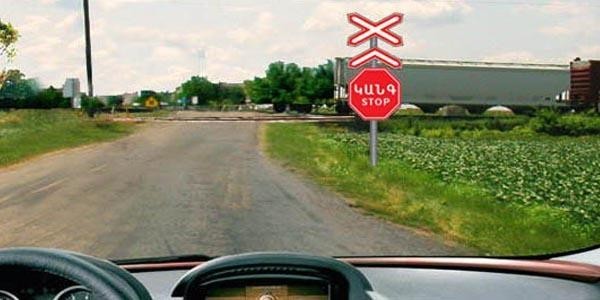
- Cross the railway crossing ensuring safety.
- Cross the railway crossing without stopping.
- Stop before the sign and, ensuring safety, cross the multi-track railway crossing.
The correct answer: Stop before the sign and, ensuring safety, cross the multi-track railway crossing.
The correct answer is “Stop before the sign and, ensuring safety, cross the multi-track railway crossing.”. The decisive details are the sign category, symbol and any supplementary plate; together they give the exact instruction. Remember: category first, symbol second, supplementary plate last.
Continue your learning journey
Your account brings together the full question bank, a personal plan, reviews and progress tracking.
Create an account and continue