Right-Hand Rule
The essentials
The right-hand rule applies when priority has not been defined in another way and the roads are of equal priority. This topic helps determine which road user approaching from the side must be given way to and when the rule does not apply.
What to remember
Apply the right-hand rule when the intersecting roads are of equal priority and no other rule determines priority. In that case, a driver gives way to a vehicle approaching from the right. First make sure the situation is truly equal-priority: where there is a main/secondary road relationship or another active form of control, ‘the right’ does not automatically have priority.
Listen to the explanation
Educational material; not a substitute for the current official rules.
Try questions on this topic
A small practice set from this subtopic. The full question bank and saved progress are available in your account.
On roads with two-way traffic, in the absence of road signs, markings and dividing strips, drivers must bypass the elements of road structures on the roadway:
- On the right
- On the left
The correct answer: On the right
On a two-way road, when no sign, marking, or central reservation specifies another route, an element of a road structure must be passed on the right. This common rule keeps vehicles approaching from opposite directions on their own side and reduces the risk of entering the opposing lane.
In which picture does the driver of the blue car have the priority rightof driving over the other driver?

- Left
- Right
- Both
The correct answer: Both
The correct answer is “Both”. The order is determined by active control and priority signs, then by road status and, under equal conditions, the right-hand rule and intersecting paths. Remember the order: control → priority signs/road status → right-hand rule when conditions are equal.
Which of the vehicle driver should give way?
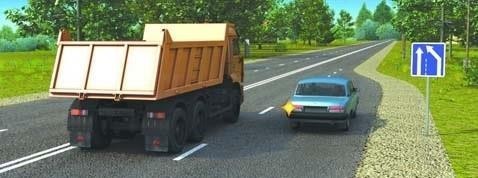
- Truck
- Passenger car
The correct answer: Passenger car
The correct answer is “Passenger car”. The order is determined by active control and priority signs, then by road status and, under equal conditions, the right-hand rule and intersecting paths. Remember the order: control → priority signs/road status → right-hand rule when conditions are equal.
Continue your learning journey
Your account brings together the full question bank, a personal plan, reviews and progress tracking.
Create an account and continue