Road Elements
The essentials
This topic presents the main elements of a road: carriageway, sidewalk, shoulder, central reservation and other structural parts. Distinguishing them helps correctly understand where rules apply and which areas are intended for different road users.
What to remember
The carriageway is intended for vehicle movement, the sidewalk mainly for pedestrians, the shoulder is an edge element of the road, and the central reservation separates opposing or other traffic flows and is generally not intended for driving. Correctly distinguishing these elements determines where you may drive, stop, park or pass an obstacle.
Listen to the explanation
Educational material; not a substitute for the current official rules.
Try questions on this topic
A small practice set from this subtopic. The full question bank and saved progress are available in your account.
In this situation
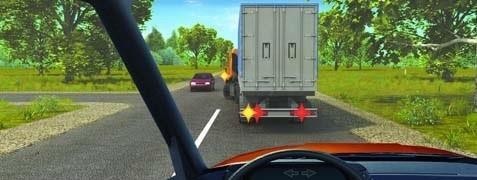
- Can we bypass the truck on the right side?
- Can we continue driving only after the truck has passed?
- Both actions are allowed
The correct answer: Can we continue driving only after the truck has passed?
The correct answer is to continue only after the truck has passed. The area on the right is a shoulder, not a traffic lane, and it may not be used for normal driving or bypassing an obstruction. Keep a safe distance and wait until the truck moves or clears the roadway.
In this case of straight driving is it allowed to
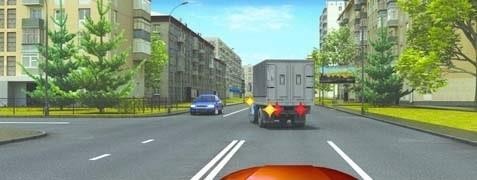
- Bypass the truck on the right
- Continue driving only after the truck has passed
- Both of these cases are permissible
The correct answer: Both of these cases are permissible
The correct answer is both actions are permitted. The truck occupies the left lane, while a full traffic lane in the same direction remains on the right; it is not a shoulder. You may safely continue in the right lane or wait, while respecting markings, speed limits, and lateral clearance.
Which lane is allowed to approach a pedestrian waiting on the curb?
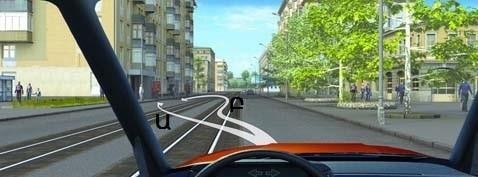
- Only A
- Only B
- Both
The correct answer: Only B
The correct answer is only trajectory B. To approach a pedestrian waiting at the curb, enter the permitted edge lane in advance without crossing a prohibiting marking or conflicting route. Trajectory B brings the vehicle smoothly alongside the curb, while A requires a sharp crossing from an incorrect road position.
Continue your learning journey
Your account brings together the full question bank, a personal plan, reviews and progress tracking.
Create an account and continue