U-Turn
The essentials
A U-turn reverses the vehicle’s direction of travel and requires sufficient space and visibility. This topic helps recognize locations and conditions where the maneuver is permitted or may be dangerous and prohibited.
What to remember
A U-turn may be made only where the maneuver is permitted and visibility is sufficient. Under current Armenian rules, it is prohibited on pedestrian crossings, in tunnels, on and under bridges/overpasses/flyovers, at railway crossings, where visibility in at least one direction is less than 100 m, in public-transport stop areas and on one-way roads.
Listen to the explanation
Educational material; not a substitute for the current official rules.
Try questions on this topic
A small practice set from this subtopic. The full question bank and saved progress are available in your account.
Moving to the leftmost lane on two-way roads with three lanes marked with markings, of which the middle lane is used for traffic in both directions (except for roads with reversing traffic control)
- Allowed
- Prohibited
- Allowed, only to overtake, bypass, turn left or U-turn.
The correct answer: Prohibited
Entering the far-left lane is prohibited because it belongs to opposing traffic. On this three-lane two-way road, only the middle lane may be used temporarily for overtaking, passing an obstruction, turning left, or making a U-turn. Those manoeuvres do not permit entry into the opposing outer lane.
Which answer correctly states the permitted direction of travel?
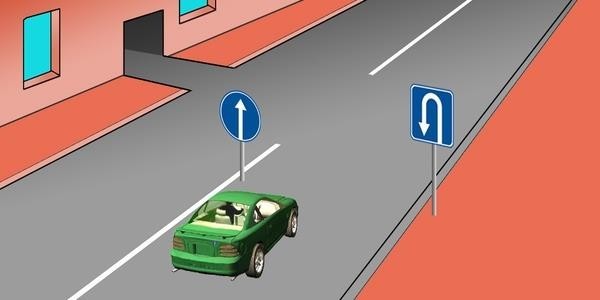
- Just a U-turn
- Straight and U-turn
- Straight ahead only
The correct answer: Straight ahead only
Only straight-ahead movement is allowed from the current position. The nearby blue circular sign requires traffic to continue straight. The rectangular U-turn sign indicates a designated place farther ahead. The driver must first reach that location and may make the U-turn only there.
Turning around is prohibited:
- On crosswalks
- In tunnels
- On bridges, overpasses and under them
- At railway crossings
- In all the above cases
The correct answer: In all the above cases
A U-turn is prohibited in every listed place: on pedestrian crossings, in tunnels, on and beneath bridges, overpasses and flyovers, and at railway crossings. These locations have restricted space or visibility, and a wide turning manoeuvre creates a serious conflict with pedestrians, road traffic, or trains.
Continue your learning journey
Your account brings together the full question bank, a personal plan, reviews and progress tracking.
Create an account and continue