Stopping Rules
The essentials
This topic explains the general rules for stopping and situations where even a short stop can obstruct visibility or traffic. The learner should combine signs, markings, road structure and nearby objects.
What to remember
Stopping is generally permitted on the right, on the shoulder or at the edge of the carriageway, and in certain built-up-area conditions also on the left. Examples of prohibited places include: on a pedestrian crossing and within 5 m before it, on the intersection of carriageways and within about 5 m from its edge, at a railway crossing, in a tunnel, on certain bridge sections, and where the vehicle hides a sign or traffic light or blocks traffic. A 15 m restriction near a public-transport/taxi stop applies where the stopped vehicle would interfere with route transport or a taxi.
Listen to the explanation
Educational material; not a substitute for the current official rules.
Try questions on this topic
A small practice set from this subtopic. The full question bank and saved progress are available in your account.
Must the bus driver on the established route give way in this situation?
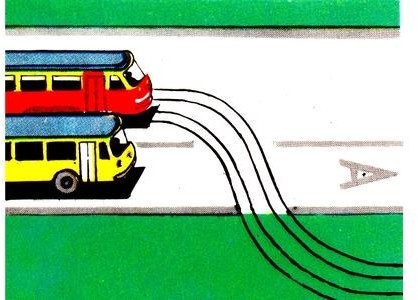
- He must
- He must not
- He must not, because he is driving straight ahead
The correct answer: He must
The correct answer is the bus driver must yield. Priority given to a route vehicle leaving a stop does not permit it to cut across a vehicle that is already alongside or too close. The bus driver must first confirm that other traffic is yielding and that the merge is safe, then enter the lane.
Are drivers of vehicles in populated areas required to give way to public vehicles starting from a designated and equipped haulting point?
- Yes
- No
The correct answer: Yes
The correct answer is yes. In a populated area, drivers must yield to a public route vehicle starting from a designated and equipped stop. The bus or trolleybus driver may move only after confirming that other drivers have noticed and are yielding.
What should the bus driver do in this situation?
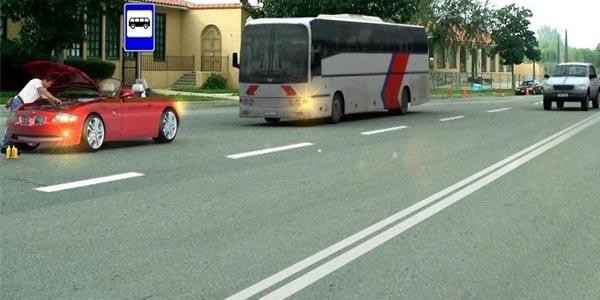
- Give way to a passenger car
- Turn on the turn signal, give a sound signal and start moving
- Start moving, making sure that the driver of the car gives way
The correct answer: Start moving, making sure that the driver of the car gives way
The correct action is to move only after confirming that the car driver is yielding. In a populated area, a route bus leaving a designated stop has priority, but that does not permit an abrupt unsafe merge. The driver signals, checks the mirrors and surrounding traffic, and enters the lane only when safe.
Continue your learning journey
Your account brings together the full question bank, a personal plan, reviews and progress tracking.
Create an account and continue